Is your creative team launching new products faster than you can print catalogues?
Leave printed catalogues behind. 🙂
Printing catalogues can be a slow and expensive process. Give your sales representatives access to new products in 3D before those products even enter production.
Every manufacturer understands what it takes to launch a new product. The marketing mix—including product photography, video and catalogues—often needs to be ready before the first products leave the production line.
Several prototypes are typically produced before launch and moved from one studio to another while marketing materials are prepared. This process is slow, costly and carries certain risks, particularly if the product changes while manufacturing is being refined. Most of us have seen cases where product photography no longer matches the final product.
This is why marketing assets are increasingly created by rendering 3D models, sometimes based on the same 3D data used for manufacturing. The process becomes faster, more affordable and considerably more flexible. If the product changes, the old model can be replaced with an updated one. If you want to present the product in the glow of a Caribbean sunset, you simply change the scene.
The speed at which manufacturers launch new products in some sectors is driving the search for even faster and more cost-effective marketing workflows. One option is to use 3D models directly for product presentation. Web-based 3D is now so established that in some sectors it is beginning to replace conventional product photography. Mobile phones are a good example: T-Mobile and O2 already use 3D models as their primary product view. The same approach is gradually expanding into other sectors, with examples including Alza, office furniture supplier JP-Kontakt and school-backpack manufacturer Topgal.
Remember the thick mail-order catalogues that once covered everything from underwear to home accessories? The internet made them disappear from our homes, and they are now retreating from the business environment as well. They are being replaced by promotional materials that focus on brand image and selected flagship products. Comprehensive printed product catalogues are gradually becoming a luxury for internal use, yet businesses still need a clear overview of their product range. A product catalogue built around 3D models combines the speed and flexibility of a digital environment with the clarity and completeness of printed material.
Why choose a 3D catalogue?
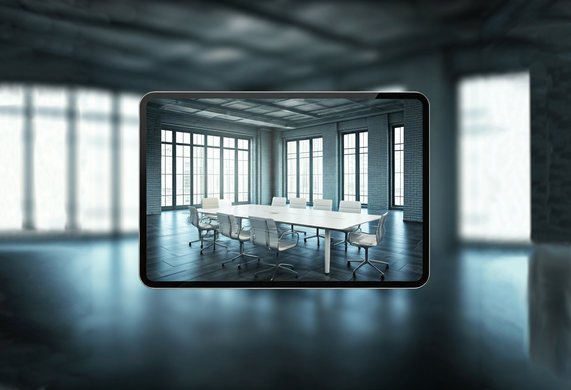
Consider a sales representative from a furniture company meeting a business owner who needs to furnish a new boardroom.
After discussing the client’s vision, the sales representative presents several styles on a tablet—including a new range they saw at a trade fair the previous week. Using a 3D Configurator, they choose from a wide range of materials and select colours for the tabletop and legs. They specify the correct table size and match it with suitable chairs. Finally, the representative uses augmented reality to place the complete arrangement in the room, helping the client understand how it will look in this important space where business decisions will be made.
- Interactivity: Customers can view the product from any angle and zoom in on important details, significantly improving engagement and understanding.
- Realism: High-quality 3D models can produce visuals that are almost indistinguishable from photography, giving customers an accurate understanding of the product before purchase.
- Wider range: Printed catalogues can show only a limited number of variants. In 3D, this limitation is virtually eliminated.
- Flexibility: Product design changes can be reflected in the 3D model and propagated throughout the catalogue. Adding or removing a material is straightforward.
- Centralisation: A 3D catalogue can be updated and synchronised across the entire company.
- Cost efficiency: Creating 3D models involves an initial investment, but it delivers long-term value by reducing the need for expensive prototypes and professional photography.
- Sustainability: Digital catalogues save paper and reduce environmental impact.
- Personalisation: 3D models make it easy to create different versions for specific markets or customers.
- Versatility: A catalogue built around 3D models can be integrated into online environments, used in presentations or provide a foundation for additional marketing materials.
3D Content is essential. Just as 3D models for marketing differ from manufacturing models, assets for the web have their own specific requirements. That is why we have specialised in creating 3D models for the web and AR from the very beginning—and why we can do it so efficiently.